Epoxy vs Polyaspartic Floor Coatings: Which Is Better for Mid-South Humidity?
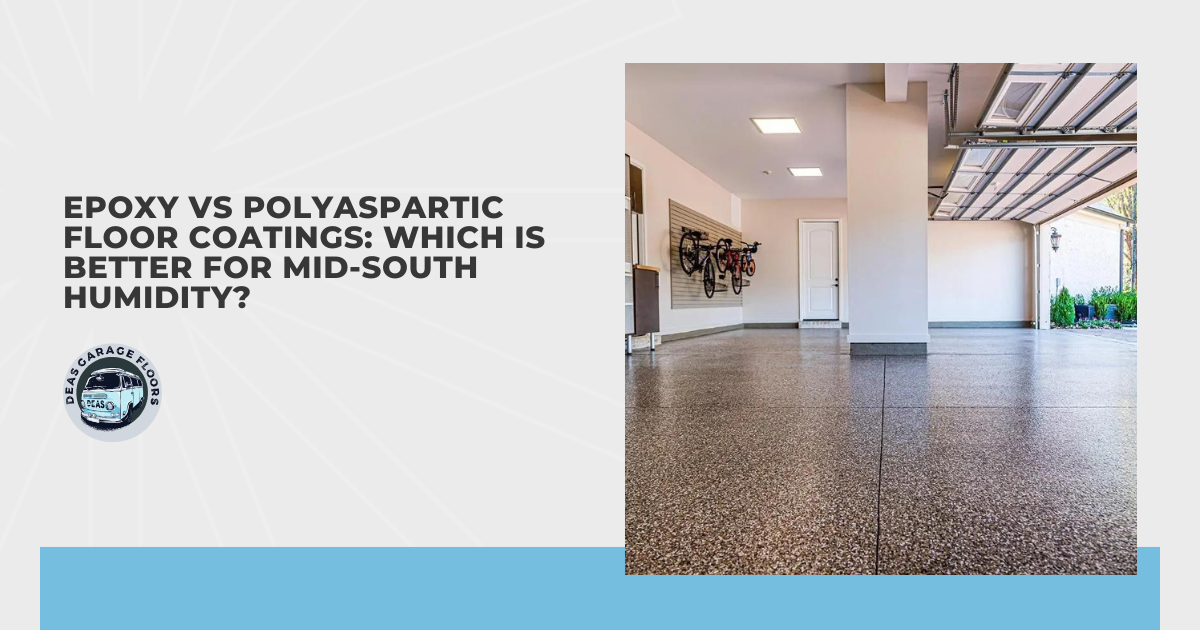
If you've lived in the Mid-South long enough, you know what summer feels like before you even step outside. The heat is one thing, but the humidity is what makes everything harder, including keeping a garage floor coating intact. Most homeowners don't think about how climate affects their flooring choice until they're dealing with a coating that's peeling, yellowing, or failing years before it should. As someone who has seen both coatings perform in these conditions firsthand, the decision between epoxy and polyaspartic floor coatings matters more in this region than most people realize.
Both coatings can produce a beautiful finished floor, but the difference shows up over time. Moisture, heat, and UV exposure that the Mid-South delivers year after year separate the coatings that hold up from the ones that don't. Knowing how they compare across the factors that actually matter in this climate is what saves you from a costly and disruptive reinstallation down the road.
Here's how epoxy and polyaspartic floor coatings stack up against each other in the conditions that matter most:
- Humidity and moisture tolerance
- UV resistance
- Cure time and application
- Durability and longevity
- Maintenance and upkeep
- So which is better?
Keep reading to find out which coating comes out ahead in each category and what that means for your garage floor.
Humidity and Moisture Tolerance
Of all the factors that affect floor coating performance in the Mid-South, humidity is the most unforgiving, and it's worth understanding before you commit to either option. Moisture in the air and moisture rising through your concrete both create conditions that can compromise a coating's bond to the floor surface. In a region where humidity levels stay elevated for months at a time, that's not a minor concern. Epoxy requires a completely dry surface to bond properly and has a narrow window for application when humidity is high, which in the Mid-South can be a real limitation.
A garage floor coated with epoxy during or after a humid stretch can develop adhesion failures, bubbling, or peeling within months of installation. Polyaspartic floor coatings handle moisture significantly better, and their chemistry allows them to be applied in higher humidity conditions without compromising the bond. Moisture vapor transmission, which is when moisture rises up through your concrete from the ground below, is also less likely to cause adhesion failure with polyaspartic coatings. For garages built on slabs without a moisture barrier beneath them, that difference in tolerance can be the deciding factor between a coating that lasts and one that doesn't.
Concrete moisture content is worth testing before any coating is applied, regardless of which product you choose. Epoxy is far less forgiving of elevated moisture readings, often requiring additional prep work, primers, or moisture mitigation systems before it can be safely applied. Polyaspartic coatings are more tolerant of moderate moisture readings, which reduces your risk of application-related failures in real-world conditions. In the Mid-South, where keeping your concrete dry is an ongoing challenge, that tolerance is a core reason why polyaspartic floor coatings tend to outperform epoxy over time.
UV Resistance
The Mid-South sun is relentless, and for garages with windows, open doors, or skylights, UV exposure is a year-round reality that takes a real toll on floor coatings over time. Epoxy performs well in many areas, but UV resistance is widely considered its most significant weakness. Prolonged sun exposure causes epoxy to yellow, amber, and develop a chalky, dull surface that signals the coating's chemical structure is breaking down. For fully enclosed garages with minimal natural light, this may never become a noticeable issue.
Polyaspartic floor coatings are inherently UV-stable, which means they maintain their color and sheen even with direct, prolonged sun exposure. That stability comes from the chemistry of the coating itself rather than a separate UV-protective topcoat, making it a more reliable long-term solution for sun-exposed spaces. If you've invested in a custom color or decorative flake system, that built-in UV protection preserves the appearance of your floor in a way that epoxy can't consistently replicate. In the Mid-South, where sun exposure is significant for most of the year, UV stability is worth weighing carefully before making a decision.
Your garage's specific conditions are what should drive this decision. From what I've observed, homeowners with sun-exposed garages who choose epoxy tend to recoat sooner than those who opt for polyaspartic floor coatings. For shaded or enclosed garages, epoxy's UV limitations matter far less and may not factor into the decision at all.
Cure Time and Application
Applying a floor coating isn't just a matter of picking a product and scheduling an installation day. Temperature and humidity both affect how coatings cure, and in a region where summer humidity regularly sits above 70%, those variables matter more than most people expect. Epoxy has a relatively long cure time, typically requiring 24 to 72 hours before light foot traffic and several days before vehicles can be parked on it. High humidity slows that process further, extending the window during which the coating is vulnerable to contamination, moisture intrusion, and surface defects.
An extended cure window is where things get complicated in a humid climate. The longer a coating sits in an uncured state, the more exposure it has to the moisture and temperature fluctuations that can compromise your finished result. Polyaspartic floor coatings cure significantly faster, often reaching full hardness within a few hours of application, which dramatically reduces that risk. They can also be applied across a wider temperature range than epoxy, giving your installer more flexibility throughout the year.
Epoxy's longer cure time also means a longer disruption to your daily routine. Clearing out your vehicles, tools, and storage for an extended period is a logistical challenge that's easy to underestimate before scheduling an installation. Polyaspartic floor coatings dramatically reduce that downtime, with most installations allowing same-day or next-day use. Downtime is a cost too, and polyaspartic floor coatings keep it to a minimum.
Durability and Longevity
Durability looks different depending on what your garage actually goes through on a daily basis. Both epoxy and polyaspartic floor coatings are engineered to handle vehicle traffic, dropped tools, and chemical spills, and both can last many years under the right conditions. The real difference between them shows up not in controlled environments but in garages that deal with the full range of what the Mid-South climate delivers year after year. Humidity, temperature swings, and UV exposure working together create a level of stress that separates coatings that were built for real-world conditions from those that weren't.
Epoxy's durability holds up well in controlled, low-humidity environments, but the Mid-South rarely offers those. Polyaspartic floor coatings are formulated with a flexibility that makes them more resistant to the minor concrete movement and thermal expansion that occurs naturally through seasonal temperature changes. What consistently surprises people after making the switch is how well polyaspartic maintains its integrity after the first few years in a demanding climate.
Both coatings will eventually show wear in a high-use environment, and neither is a permanent solution without some level of maintenance. Peeling, chipping, and surface degradation tend to appear sooner with epoxy in humid, high-UV conditions than manufacturers' timelines suggest. Polyaspartic floor coatings hold up longer under these conditions, which is why they've become the preferred choice for garages that need to stay looking sharp without frequent recoating. Knowing how your garage gets used day to day is what makes the durability comparison meaningful rather than abstract.
Maintenance and Upkeep
A floor coating that looks great on installation day is only as good as how well it holds up between cleanings and over years of daily use. Both epoxy and polyaspartic floor coatings are easier to maintain than bare concrete, but the level of effort required to keep each one looking its best differs in ways that become more apparent over time. Epoxy's smooth, non-porous surface is easy to wipe down and resistant to most common garage spills when the coating is intact. Once it starts to peel, chip, or degrade, however, those compromised areas trap dirt, moisture, and chemicals in ways that accelerate the deterioration and make cleaning progressively harder.
Routine maintenance for a floor that stays intact is straightforward: a regular sweep and an occasional mop with a neutral cleaner is genuinely all it takes. The challenge with epoxy in a demanding climate is that the maintenance routine changes as the coating ages, requiring more frequent attention to areas where the surface has started to break down. Resealing, spot repairs, and eventually recoating become part of the equation in ways that aren't always obvious when the floor is first installed. A coating that holds its surface integrity longer simply asks less of you over time, and in the Mid-South that difference compounds with every passing season.
Recoating is worth factoring into the long-term maintenance picture for both options. Epoxy recoating in a humid climate requires careful surface preparation, moisture testing, and often a longer window of dry weather than the Mid-South consistently provides. Polyaspartic floor coatings are more forgiving in that regard, and when recoating is eventually needed, the process is faster and less dependent on ideal weather conditions. For a region where humidity is a constant variable rather than an occasional inconvenience, that difference in maintenance demands adds up significantly over the life of your floor.
So Which Is Better?
For most garages in this region, polyaspartic floor coatings are the stronger choice, and the reasoning goes beyond just humidity tolerance. If your garage sees daily vehicle traffic, gets direct sun exposure through windows or an open door, and deals with the kind of temperature swings that come with the local climate, polyaspartic addresses all of those challenges in a way that epoxy simply wasn't designed to. The faster cure time also means installation is less dependent on finding a stretch of dry, low-humidity weather, which can be harder to come by than most people expect when they're scheduling the work. For garages that check most of those boxes, the performance gap between the two coatings becomes hard to ignore over time.
Epoxy still makes sense in specific situations, and it's worth being honest about what those are. If your garage is fully enclosed, sees lighter use, and you're working within a tighter budget, epoxy can deliver a good-looking and functional floor for years before recoating becomes necessary. The key is going in with realistic expectations about how the coating will perform as it ages in your specific conditions, rather than assuming the results will match what you'd see in a climate with less humidity and UV exposure. Epoxy chosen with clear eyes and the right conditions behind it is a far better outcome than polyaspartic chosen without understanding what you're paying for.
Conclusion
Humidity changes the equation for garage floor coatings in ways that aren't always obvious until a floor starts failing. Both epoxy and polyaspartic floor coatings can deliver a beautiful, functional garage floor, but the Mid-South's combination of moisture, heat, and UV exposure puts real pressure on a coating's ability to bond, cure, and hold up over time. Polyaspartic floor coatings were built for exactly those conditions, which is why they consistently outperform epoxy in this region over the long term. Epoxy has its place, but in a climate this demanding, going in with a clear understanding of its limitations is what keeps you from an expensive and avoidable reinstallation.

CONTACT INFO
DEAS Garage Floors
12210 Dargie Dr,
Arlington, TN 38002
Phone
SCHEDULE A CONSULTATION
Contact us, and we will come out and discuss your project free of charge.